
The Reason
In the AI era, we can produce more per person than we ever have before. The opportunities are immense, but so are the dangers.

This is the "why" behind us choosing to build Hooby Flow. Jump to The Rationale for the "why" behind its design.

The headings in the On this page section tell the high-level story, click any of them for the details.
Alignment is Hard
Ask a room of executives whether sales, marketing, and customer success are aligned, and most will say yes. 82% of leaders describe their teams as aligned. Ask the people actually doing the work and the picture flips: 65% report misalignment between their own leaders. A separate study of 350 GTM professionals found the identical paradox living inside a single team: 85%/85% paradox — confident in their process, yet experiencing misalignment weekly or monthly.
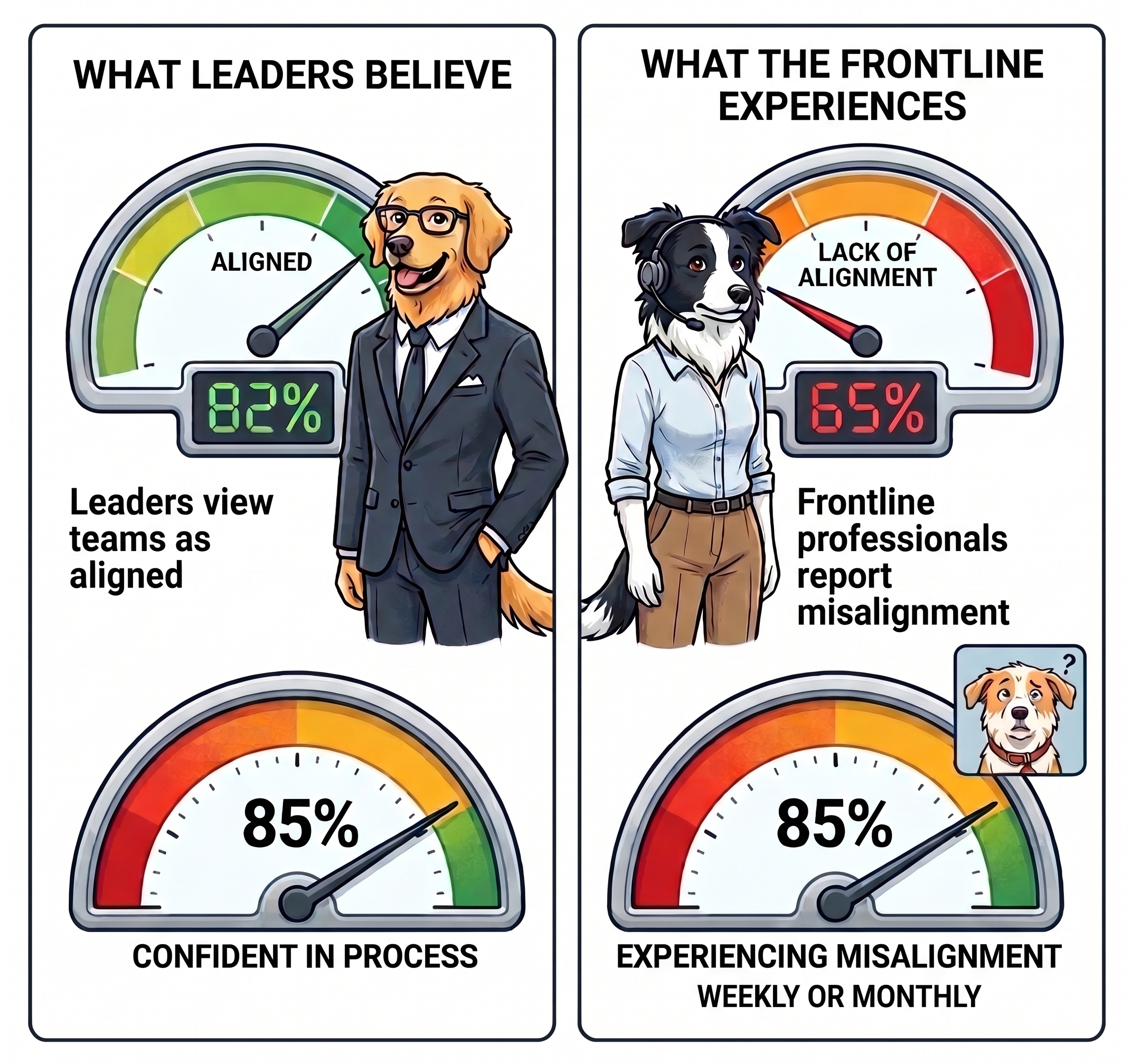
The breakdowns underneath that gap are structural, not personal. Gartner has found that marketing and sales collaborate on only three of fifteen commercial activities they jointly own, and just 17% co-build a buyer journey map together. "Qualified" means one thing to marketing and another to sales, with no written definition either side has to honor. Context gathered over months of a sales cycle routinely evaporates the moment an account moves to customer success. Commitments go undocumented, and the person who closed the deal is often the only one who remembers what was promised.
Every one of these failures shares a root cause: there's no shared, visible record of the process itself, just private definitions, disconnected tools, and institutional memory that walks out the door with whoever leaves. Quarter over quarter, teams re-litigate the same handoffs instead of pointing at an answer everyone already agreed to.
We're overloaded with AI-generated text
The instinct is to fix the alignment problem by writing more: more recaps, more summaries, more AI-drafted updates to keep everyone in the loop. But the volume has already outrun anyone's ability to read it. 74.2% of pages newly published on the web now contain AI-generated content, and even buyers researching a single purchase now wade through seven information sources on average trying to sort it out. None of that volume is gated by headcount anymore. It scales independently of how many people are actually available to read, check, or act on it.
Worse, almost nobody is checking it before it moves. A 2025 study that surveyed over a thousand employees gave this a name, "workslop": AI-generated content that looks finished but doesn't hold up. 40% received workslop in the past month, and each instance costs the person who receives it nearly two hours to untangle. This isn't confined to sloppy internal teams, either. Deloitte, EY, KPMG, and PwC have each been caught publishing "thought leadership" reports with fabricated citations and hallucinated sources, one of them inventing an entire government framework that doesn't exist. If the largest professional-services firms in the world aren't catching this in their own published research, a team's Slack recap or deal-review deck isn't getting a harder look.
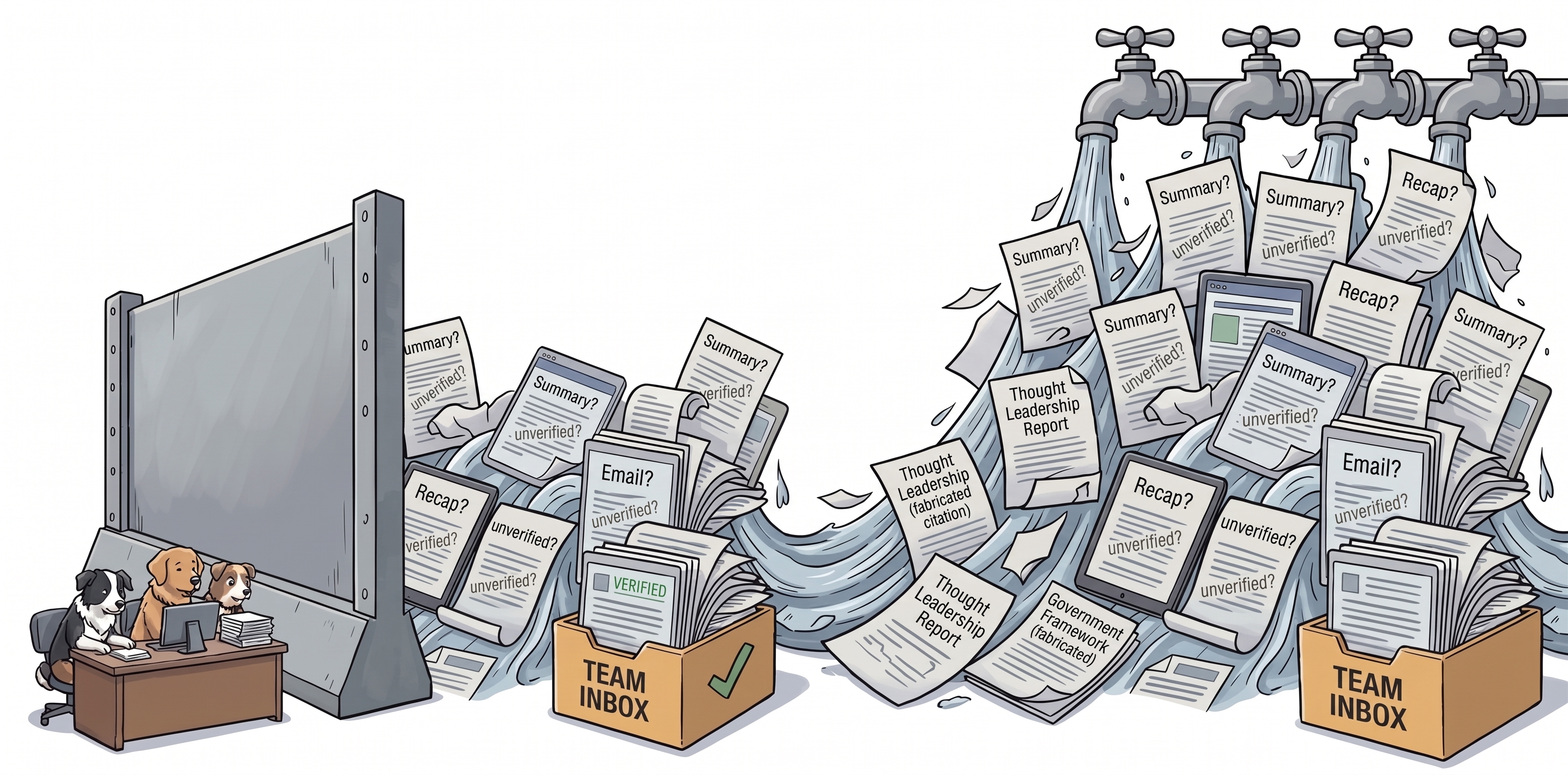
More text was never going to buy more alignment. It just gives an already-strained team more to reconcile. What revenue teams really need is a solution that captures how the work actually happens, aligns everyone around it, and lightens the cognitive load instead of stacking more onto it.
Flowcharts communicate human processes best
Flowchartnoun
A flowchart is the diagram itself: boxes for steps, arrows for the order they happen in, and diamonds for the moments a process branches. It's the visual notation that turns a sequence of decisions into something you can follow at a glance.
Process Mapnoun
A process map is the underlying structure a flowchart depicts: the actual steps, decision points, and handoffs that make up how work gets done. You can represent the same process map as a flowchart or a checklist, but the map itself is the process, independent of how you choose to represent it.
There's a well-evidenced alternative to writing more prose, and it isn't new. It's just underused. Diagrams and text can carry the exact same information and still be radically different to use, because a diagram indexes information by location: everything relevant to one step of a process sits together on the page, so the reader isn't stuck cross-referencing paragraphs to reconstruct how two things connect. Researchers call this "computational offloading": the diagram does part of the reasoning for you. That advantage is largest specifically for the kind of thinking a process map requires: what happens next, and where does this branch go. Decades of cognitive-fit research confirm graphical formats beat text and tables precisely on that spatial, relational class of task.
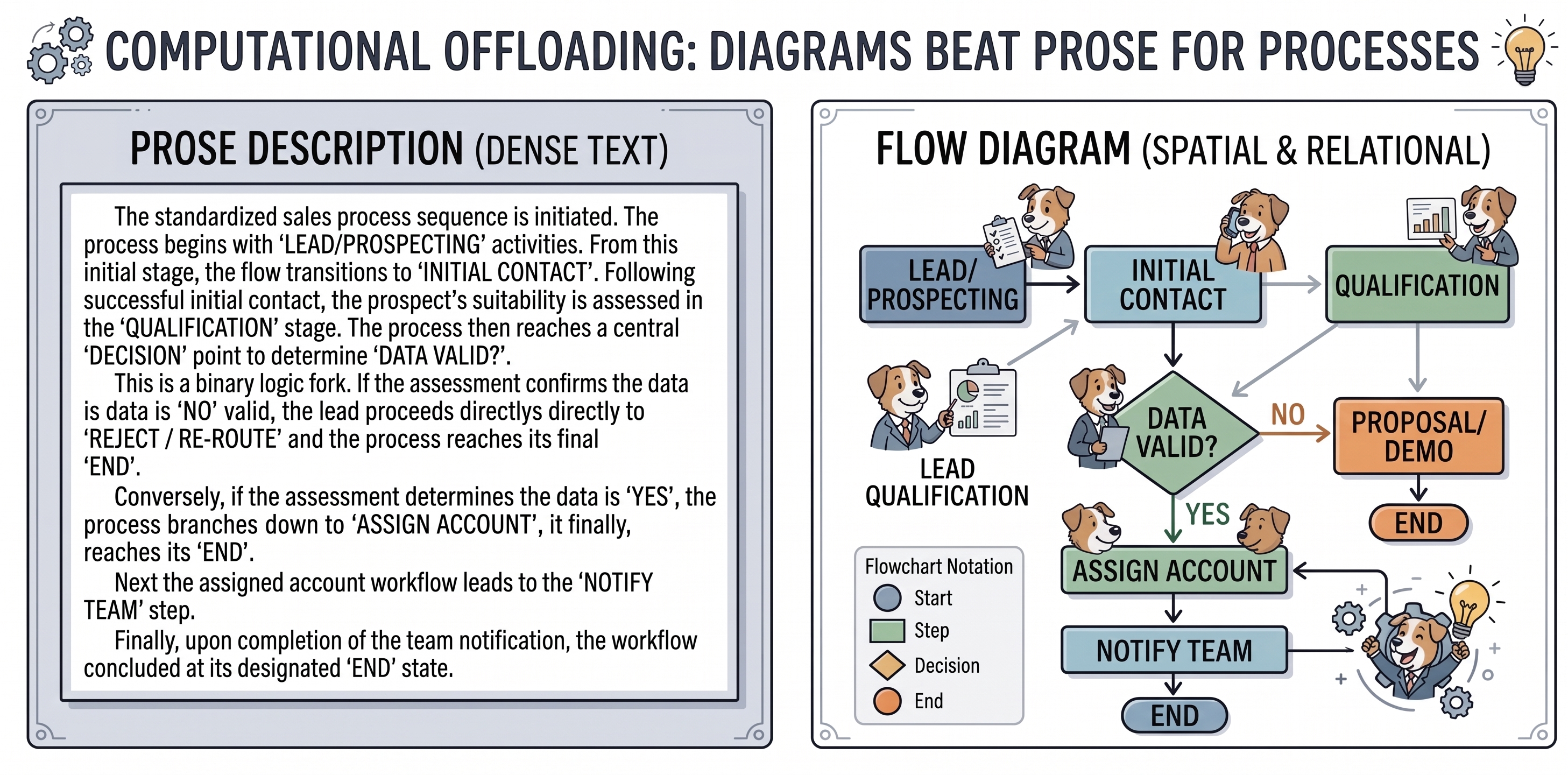
A good diagram also does something prose can't: it becomes a single object a team can point to. Cognitive research on distributed cognition shows that an external representation doesn't just record a decision. It carries part of the group's shared reasoning, external to any one person's memory. That's the piece missing from every failure mode in "Alignment is Hard": not more communication, but one visible, durable artifact the whole team can look at, edit, and settle disagreements against instead of re-arguing them from memory every quarter.
None of this is automatic, though. The advantage only shows up when diagrams are actually well-structured, and that's a specialized skill, closer to information design than to anything a sales, marketing, or support role trains someone to do.
The Flow is the simplified & enhanced flowchart you maintain in Hooby Flow. Read The Rationale to understand why its designed the way it is. Jump to What's a Flow? to get right into the details.
Good flowcharts are difficult to produce and maintain
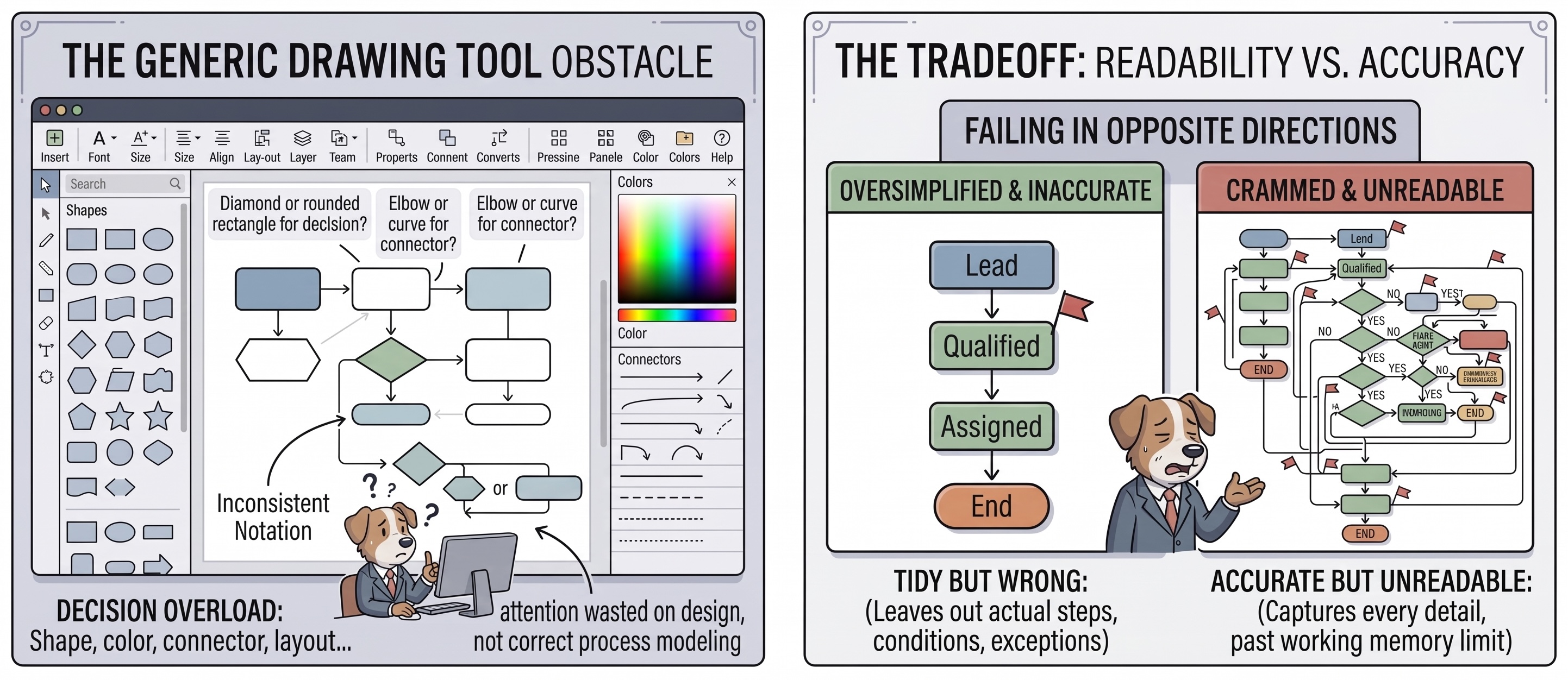
Generic drawing tools are the first obstacle, not the fix. Tools like Lucidchart, Mural, Miro, Canva, etc. are all built to draw literally anything: org charts, network diagrams, wireframes, mind maps, and flowcharts, on the same blank canvas. That flexibility means every shape, connector style, color, and layout choice becomes a decision the person mapping a process has to make alone, before they've captured a single step of the process itself.
That's a lot to ask of someone whose job is running a sales process, not designing complex diagrams. A first-time flowcharter spends real attention deciding whether a decision point should be a diamond or a rounded rectangle, attention that has nothing to do with whether the decision they're modeling is even correct. Multiply that across a team and the result is predictable: every flow looks a little different, because nobody was ever handed a fixed, shared vocabulary to draw within. Comprehension research is clear that this matters: a diagram only pays off once the reader is fluent in its notation, and inconsistent notation forfeits that advantage before a reader even starts.
Even a confident diagrammer runs into a second, harder trade-off: completeness fights clarity. Capture every step, condition, and exception in a real process and the diagram grows past what anyone can take in at a glance. Leave enough out to keep it readable, and it quietly stops being the actual process. Working memory reliably holds only a handful of chunks at once, so a flat diagram of a real process runs out of room fast. Most flowcharts end up picking a side of that trade-off by accident: tidy but wrong, or accurate but unreadable.
A combination of features in Hooby Flow work together to tackle these challenges. Jump to The Rationale to learn more.
A few best practices guide your teams to successful adoption. Jump to Adopting the Flow to learn more.
Flowcharts aren't followed and go stale
A diagram made in a generic drawing tool doesn't live where the work happens. To be useful, it has to be exported, as a PDF or an image, and dropped somewhere the team can find it: a shared drive, a wiki page, a deck. That hop from "the file I built" to "the file everyone else sees" is a manual step someone has to remember to repeat every time the process changes.
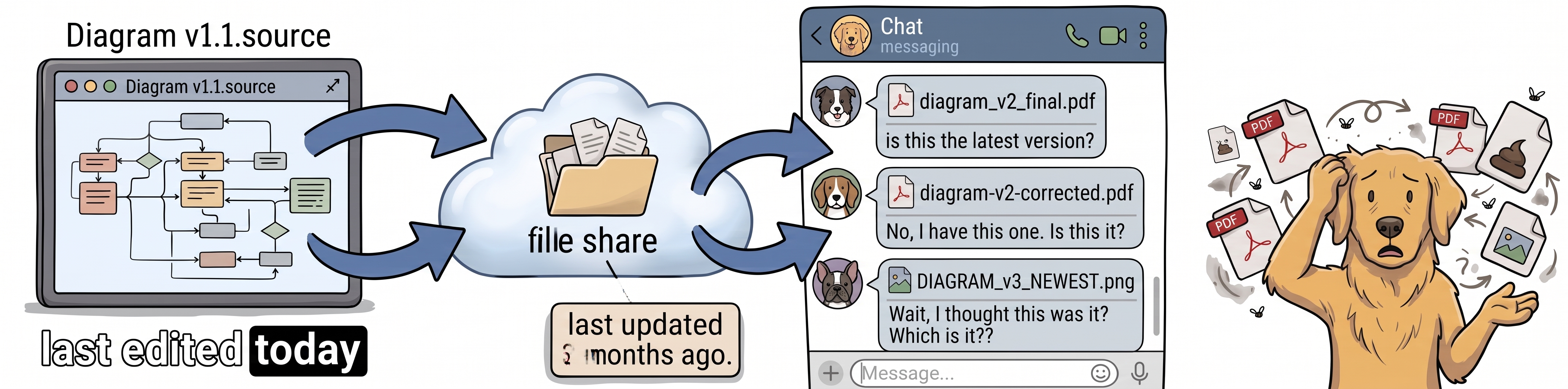
That gap is exactly where staleness creeps in. The moment the underlying process changes, the source file and the exported copy start to drift apart, and nothing forces them back into sync. Finding the diagram stops being enough; someone also has to ask whether it's still accurate, and increasingly the honest answer is "probably not."
The coordination cost that creates is exactly the overhead the diagram was supposed to remove. Instead of one glance at a shared source of truth, a team spends time confirming which folder holds the latest version, who exported it last, and whether last week's change actually made it in. A document meant to reduce friction ends up adding a new kind of it: not "do we agree on the process," but "are we even looking at the same version of it."
Hooby Flow puts your live process map where your teams need it. Jump to Navigating the Flow and Maintaining the Flow to learn more.
Flowcharts aren't integrated with your CRM
A finished flowchart, however well built, is still just a picture. It has no idea what stage a real deal is in, whether a step actually got completed, or how long accounts sit at any point along the way. The map lives in a drawing file; the process it describes lives in the CRM. Nothing connects the two.
That disconnect keeps the diagram permanently one step removed from reality. A rep can't glance at a step and see how many deals are stuck there right now. A manager can't click a bottleneck and see which accounts are waiting on it. A shared picture of the process and the live record of where every deal actually sits in it end up as two separate artifacts, in two separate tools that were never built to talk to each other.
There's real, untapped potential sitting in that gap. A process map is already structured as steps and transitions, which is exactly the shape a CRM's pipeline stages, statuses, and workflows take too. Instead of a static picture that only describes the process from a distance, the same diagram can become the scaffolding the data attaches to directly: a step that shows the deals currently sitting in it, a decision branch that shows which way accounts actually went. The map stops just describing the territory and starts becoming part of it.
We've tackled getting your HubSpot pipeline stages, workflows, sequences, campaigns, forms, and settings available as accessories on your Hooby Flows. Jump to HubSpot Accessories to learn more.

Effective AI solutions in the revenue space require context
HubSpot itself is racing to put AI to work across the CRM. Its Fall 2026 Spotlight, which HubSpot calls its most foundational release yet, rebuilt the platform on what it calls Growth Context: a self-updating Smart CRM that captures calls, emails, and meetings on its own, an all-new Breeze Assistant that hands your request to the right agents, a Prospecting Agent that watches more than 40 buying signals, and Deal Progression that turns call transcripts into CRM updates and deal plans. HubSpot even added a Context Home that scores how complete your context is and shows where the gaps are, because agents only perform as well as the context they draw on.
Look closely at what that context actually is, though. HubSpot says it brings together your business, your team, and your customers, and in practice that means customer data, behavioral signals, and operational history: what a contact clicked, what a deal's stage history looks like, what a ticket said. Layer your team's actively maintained process map on top of that context, and an AI agent working a deal stops just seeing what the deal looks like today. It sees what should happen to it next, who owns the handoff, and the criteria your org actually uses to move it forward.
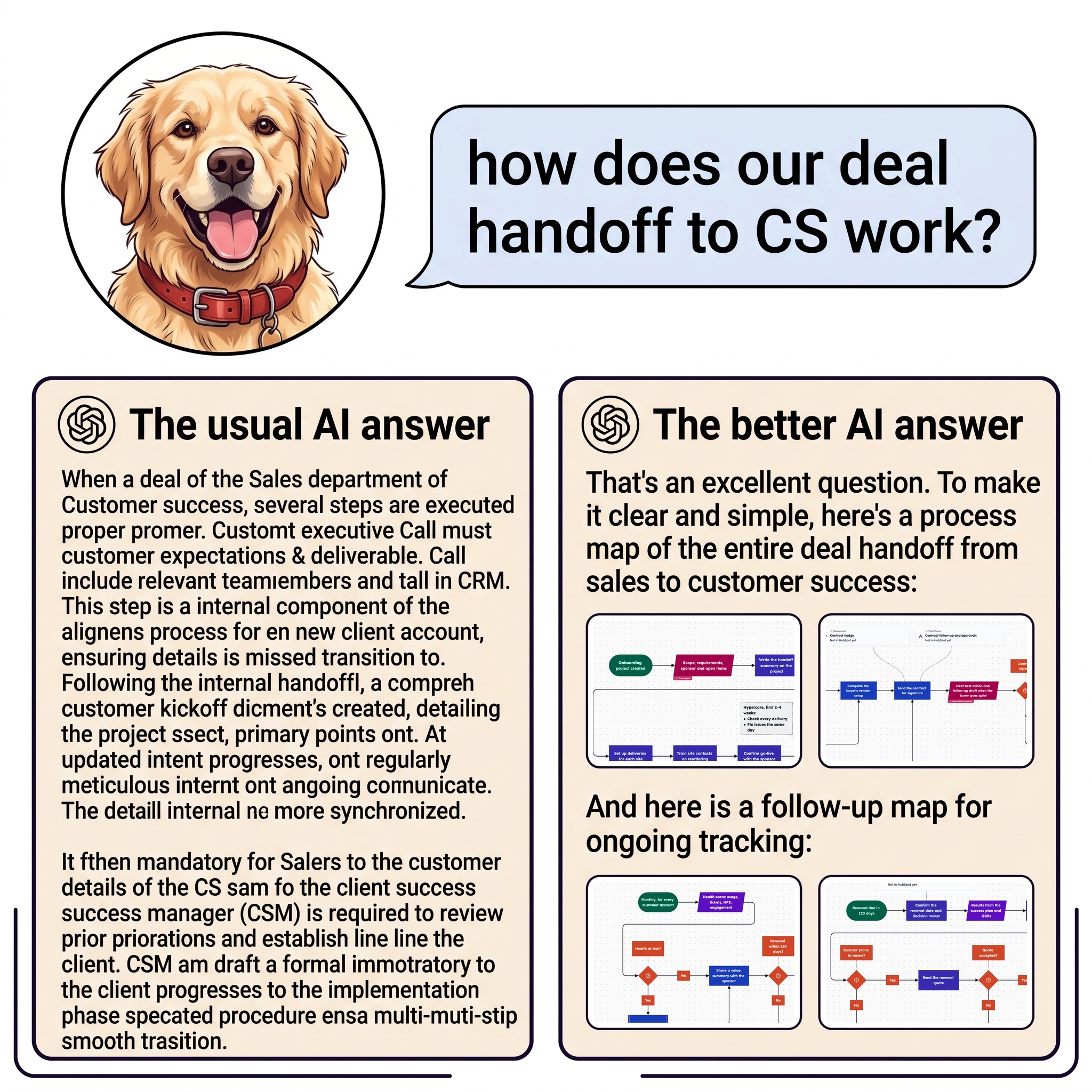
That's the gap a CRM-integrated process map fills that customer data alone can't. A well-built process map is the org's source of truth for how the work is actually supposed to happen: the sequence, the decision points, the ownership. An agent that can see that structure, not just the data sitting inside it, knows where it stands in the surrounding people process: what step it's acting on behalf of, what the next handoff is, who to escalate to when a decision falls outside its guardrails. Process context makes agentic AI more accurate for the same reason it makes people more aligned: it replaces a guess with a shared answer.
That same pairing pays off well beyond AI agents, too. Give any AI in the business the org's actual flowcharts to draw from, and a question that used to trigger a wall of generated prose (how does onboarding work, what's the handoff from sales to CS) can instead return the specific diagram that already answers it. For a new hire ramping up, or a team trying to stay aligned quarter over quarter, that's a categorically different kind of answer: not another paragraph to read and hope is accurate, but the same visible, durable process everyone else is already working from.
Daywards has the skill & drive to build something better
Hooby Flow is Daywards' first HubSpot Marketplace app, but our team has shipped useful software for startups and enterprises in healthcare, retail, logistics, energy, social, and the hard sciences for over two decades.
We've felt the guilt knowing that the chaos and friction we're absorbing at our workplaces is traveling home with us to our friends and families. We can't change how business is done in our beleagured world, but we can build tools that truly help people work better together.
Read on to The Rationale for the "why" behind Hooby Flow's design choices & review our Roadmap to see where we're going.
- The Reason
- Alignment is Hard
- We're overloaded with AI-generated text
- Flowcharts communicate human processes best
- Good flowcharts are difficult to produce and maintain
- Flowcharts aren't followed and go stale
- Flowcharts aren't integrated with your CRM
- Effective AI solutions in the revenue space require context
- Daywards has the skill & drive to build something better